
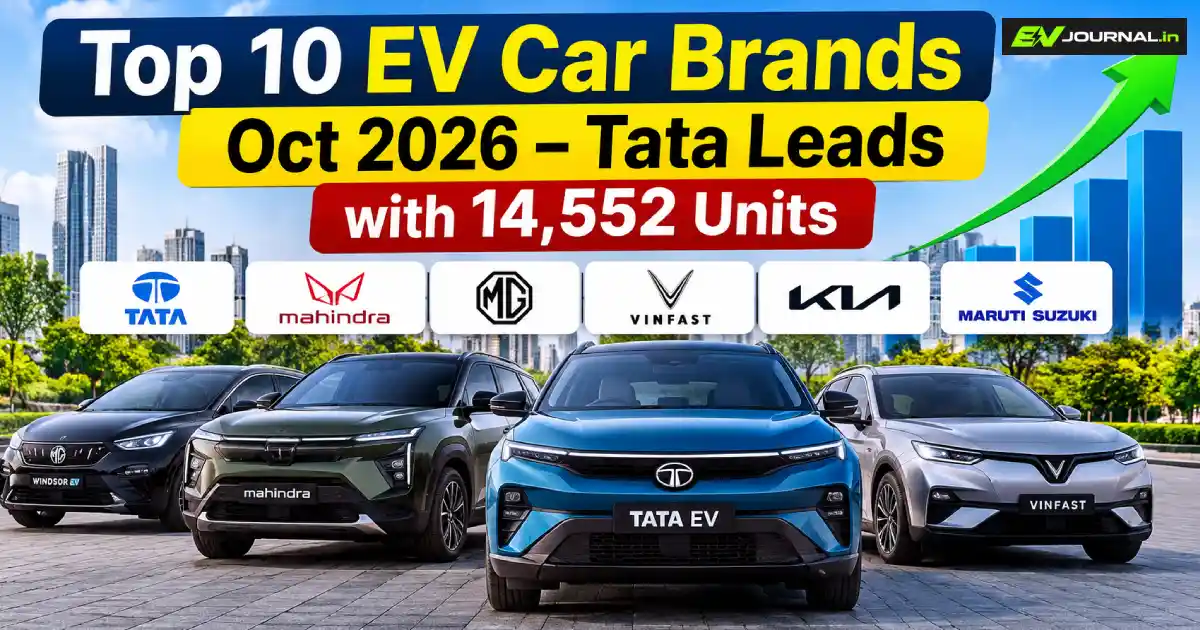
In India’s electric passenger vehicle market, Tata Motors has once again maintained the top position in the October 2026 EV Car Sales. According to the brand-wise rankings for October, Tata Motors recorded 14,552 units.
While Mahindra secured the second position with 8,472 units, and MG followed in third place with 5,877 units.
Follow EVJournal.in on X for the latest EV news & updates instantly!
There was a gap of 6,080 units between Tata Motors and the second-placed Mahindra, which highlights Tata’s strong lead during the month of October. VinFast secured the fourth position with 2,565 units, while Kia and Maruti Suzuki took the fifth and sixth spots, respectively.
An interesting aspect of these October 2026 EV Car Sales rankings is that the top three manufacturers—Tata Motors, Mahindra, and MG—collectively recorded 28,901 units. This accounts for approximately 80.8% of the 35,777 total units recorded by the 10 manufacturers listed in the table.
Also Read: Hyundai Ioniq P: Expected Launch, Platform, Features & What We Know So Far
October 2026 EV Car Sales: Top 10 EV Car Brands
The brand-wise rankings and reported sales figures for October 2026 are provided below:
| Rank | EV Manufacturer | October 2026 Units |
|---|---|---|
| 1 | Tata Motors | 14,552 |
| 2 | Mahindra | 8,472 |
| 3 | MG | 5,877 |
| 4 | VinFast | 2,565 |
| 5 | Kia | 1,386 |
| 6 | Maruti Suzuki | 1,188 |
| 7 | Hyundai | 753 |
| 8 | BYD | 735 |
| 9 | Toyota | 189 |
| 10 | Stellantis | 60 |
Note: These figures represent brand-wise data for October 2026, as provided in the source report. They should not be combined with broader sales data for two-wheelers, three-wheelers, or commercial EVs. Variations in these figures may occur due to differences in data snapshots and registration updates.
Tata Motors Maintains a Significant Lead
In October 2026, Tata Motors led the rankings with 14,552 units. The company’s electric passenger vehicle portfolio spans multiple segments in the Indian market, offering buyers a variety of options across different price ranges and body styles.
Tata Motors’ tally for October was 6,080 units higher than that of the second-placed Mahindra, and 8,675 units ahead of MG.
This gap demonstrates that, based on the reported figures for October, Tata Motors maintained a substantial lead over its closest competitors.
Mahindra Takes Second Position, MG Remains Third
Mahindra secured the second position in October 2026, recording 8,472 units. The company’s electric SUV portfolio includes models such as the XEV 9e and BE 6, with the XEV 9S also forming part of its future electric vehicle roadmap.
MG held the third position with 5,877 units. The Windsor EV is a key model in the company’s electric vehicle lineup, strengthening MG’s presence in the Indian electric car market.
There was a difference of 2,595 units between Mahindra and MG. Together, the two companies recorded 14,349 units, highlighting their combined market presence in October.
VinFast Secures Fourth Position
Vietnamese electric vehicle manufacturer VinFast achieved the fourth position in October with 2,565 units.
While VinFast’s figures were significantly lower than those of MG, the company remained 1,179 units ahead of the fifth-placed Kia.
VinFast is a relatively new entrant in the Indian EV market. Therefore, it will be interesting to monitor the company’s sales performance and market position in the coming months.
Also Read: Ather Energy Q2 FY27 Results: Revenue Jumps 63%, Net Profit Reaches Rs. 1.26 Crore
A Close Contest Between Kia and Maruti Suzuki
Kia secured the fifth position with 1,386 units, while Maruti Suzuki stood in sixth place with 1,188 units.
There was a difference of only 198 units between the two manufacturers—one of the closest margins in the middle of the October rankings.
For Maruti Suzuki, the e-Vitara is a key electric SUV model. Its production is supported by the Gujarat facility, which supplies vehicles to both the domestic and export markets.
The figures for Kia and Maruti indicate that, beyond the top four, there is a noticeable gap in sales volumes among the remaining manufacturers.
Hyundai Just 18 Units Ahead of BYD
The competition between Hyundai and BYD in the October rankings was even tighter.
Hyundai secured the seventh position with 753 units, while BYD took eighth place with 735 units—a difference of just 18 units.
This represents the narrowest gap in the rankings; even a minor monthly fluctuation could shift the positions of both brands next month.
Toyota and Stellantis Round Out the Top 10
Toyota recorded 189 units in October 2026, placing it ninth, while Stellantis took the tenth spot with 60 units.
There was a difference of 129 units between Toyota and Stellantis. The October tallies for both manufacturers were significantly lower than those of the top eight brands.
What Do the October 2026 EV Sales Figures Reveal?
The reported October 2026 EV Car Sales highlight several key trends in the Indian electric passenger vehicle market.
First, Tata Motors maintained its lead, staying well ahead of Mahindra and MG. Second, the top three manufacturers accounted for approximately 80.8% of the total reported sales volume. This means that a major share of sales in the October rankings remained concentrated among a few leading manufacturers.
By securing the fourth position, VinFast demonstrated its presence among established brands. Meanwhile, there was close competition between Kia and Maruti Suzuki, while the gap between Hyundai and BYD was just 18 units.
In the coming months, new electric vehicle launches, pricing, product availability, and customer demand could influence the rankings of these manufacturers.
EVJournal Says…
Tata Motors emerged as the clear leader in the October 2026 EV Car Sales rankings, while Mahindra and MG maintained the second and third positions. The combined contribution of the top three manufacturers highlights their strong presence in this market.
However, monthly rankings should not be considered the definitive indicator of a brand’s long-term market leadership. The competitive landscape may shift due to upcoming launches, new variants, and changes in customer demand.
For EV buyers, relying solely on a brand’s monthly sales figures is not the best way to make a purchasing decision. It is equally important to compare factors such as range, charging infrastructure, battery warranty, after-sales service, and the overall cost of ownership.
Data attribution: October 2026 brand-wise figures as reported by GaadiWaadi. Figures may vary across registration-data snapshots and reporting methodologies.
Also Read: Best Electric Scooters for Apartment Residents (2026): What Should You Buy?