
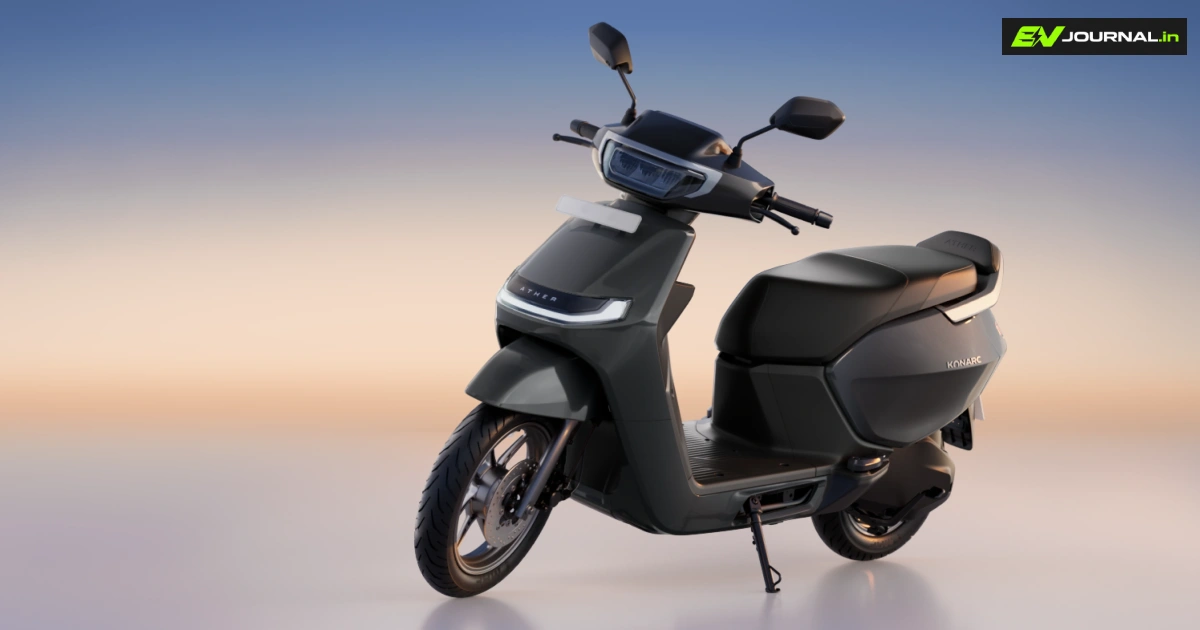
In India’s electric two-wheeler market, competition is not limited merely to selling a higher number of scooters. An equally significant challenge for companies is ensuring that as sales grow, the business also becomes profitable. Ather Energy Q2 FY27 Results highlight this very challenge, as the company has reported a quarterly net profit for the first time, alongside revenue growth.
Follow EVJournal.in on X for the latest EV news & updates instantly!
On October 26, 2026, Ather Energy reported its financial results for the September quarter, marking the first time the company recorded a quarterly consolidated net profit. Ather’s net profit stood at Rs. 1.26 crore, a stark contrast to the net loss of Rs. 154.07 crore reported in the same quarter the previous year.
The company’s revenue from operations also grew by approximately 63% year-on-year, reaching Rs. 1,464.24 crore. But does a single profitable quarter mean that Ather’s financial turnaround is complete? To understand this, one must examine revenue, operating margins, vehicle sales, and future expansion plans in conjunction.
Also Read: Top 5 Long-Range Electric Scooters in India Under Rs. 1.5 Lakh (2026 Edition)
Ather Energy Q2 FY27 Results: Key Highlights
The key highlights from the consolidated results for the quarter ending September 30, 2026, are as follows:
- Net profit: Rs. 1.26 crore, compared to a net loss of Rs. 154.07 crore in the same quarter last year.
- Revenue from operations: Rs. 1,464.24 crore, an increase of approximately 63% year-on-year.
- Total income: Rs. 1,526.95 crore (including other income).
- Vehicle volumes: 93,211 units—a 42% year-on-year increase, according to the company.
- EBITDA: Rs. 74.2 crore, as reported by the company.
- EBITDA margin: 4.9%, compared to -9.6% a year earlier, as reported by Ather.
These figures indicate that the improvement was not limited solely to the net profit line; growth was also observed in revenue, vehicle volumes, and operating performance. Nevertheless, net profit should be distinguished from operating earnings, as they represent two different financial metrics.
How Much Did Revenue Growth Help?
Ather’s revenue from operations increased from Rs. 898.88 crore a year ago to Rs. 1,464.24 crore. This indicates that the company significantly scaled up its business operations during the quarter.
Vehicle volumes also rose by 42%, reaching 93,211 units. When a company sells more vehicles, it gains the opportunity to spread factory operations, distribution networks, and other fixed costs across a larger number of units. This can lead to “operating leverage”—meaning that as sales grow, operating performance can improve.
However, higher sales do not automatically guarantee profit. If the cost of manufacturing each vehicle—along with discounts, warranty expenses, or operating expenses—rises sharply, the company could still incur a loss despite revenue growth.
In this quarter, Ather saw an improvement in margins alongside revenue growth, which is a significant aspect of the reported results.
The Role of Product Mix and Pricing Decisions
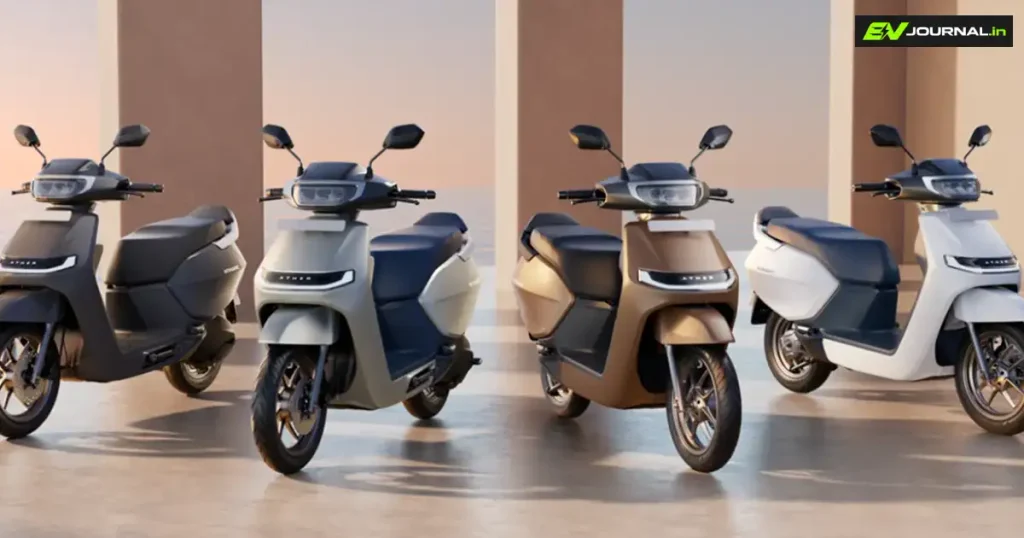
Along with its financial results, Ather noted that its product mix and pricing decisions contributed to margin improvement. Simply put, the company’s profit does not depend solely on the number of scooters sold; it also depends on which specific products were sold and how they were priced.
If the sales mix shifts toward models with better unit economics, overall margins can improve. Adjustments to pricing can also support revenue per vehicle, though the ultimate impact depends on customer demand.
The company also reported growth in “non-vehicle revenue“—which includes sources such as AtherStack Pro, its charging network, accessories, spare parts, and services. According to Ather, non-vehicle revenue now accounts for 15% of its revenue from operations, up from 12% a year ago.
This type of revenue mix helps diversify the business, reducing its reliance solely on the sale of new scooters. However, the long-term stability of this revenue’s contribution remains to be seen in future results.
Also Read: Bondada T1 Electric Two-Wheeler Unveiled at Rs. 59,999; Pre-Bookings Open
What Does It Mean to Have a Positive EBITDA?
The term “EBITDA” frequently appears in financial results, so it is useful to understand what it means.
EBITDA stands for Earnings Before Interest, Taxes, Depreciation, and Amortisation. It serves as a measure of a business’s operating performance, though it is not the same as the final net profit.
In Q2 FY27, Ather reported an EBITDA of Rs. 74.2 crore, with an EBITDA margin of 4.9%, according to the company. A year earlier, the EBITDA margin had been negative 9.6%.
An important distinction to note here is that even with a positive EBITDA, a company’s final net profit can still be very low. The final result differs once interest, depreciation, taxes, and other accounting items are factored in.
For this quarter, Ather reported a consolidated net profit of ₹1.26 crore. Therefore, rather than simply concluding that “the company has become profitable,” one should track both the operating margin and the net profit.
Can Ather’s Profit Be Sustainable?
This is the most important question for readers. A positive result for a single quarter is a milestone, but establishing sustainable profitability requires looking at performance over multiple quarters.
There are several positive indicators in Ather’s favor:
- Strong year-on-year growth in revenue and vehicle volumes.
- A shift in EBITDA margin from negative to positive territory.
- Improvement in reported margins driven by product mix and pricing decisions.
- An increasing contribution from non-vehicle revenue streams, such as software, charging, accessories, and services.
- The company’s plans to expand production capacity to meet future demand.
However, there are also risks.
Raw material and supply-chain costs
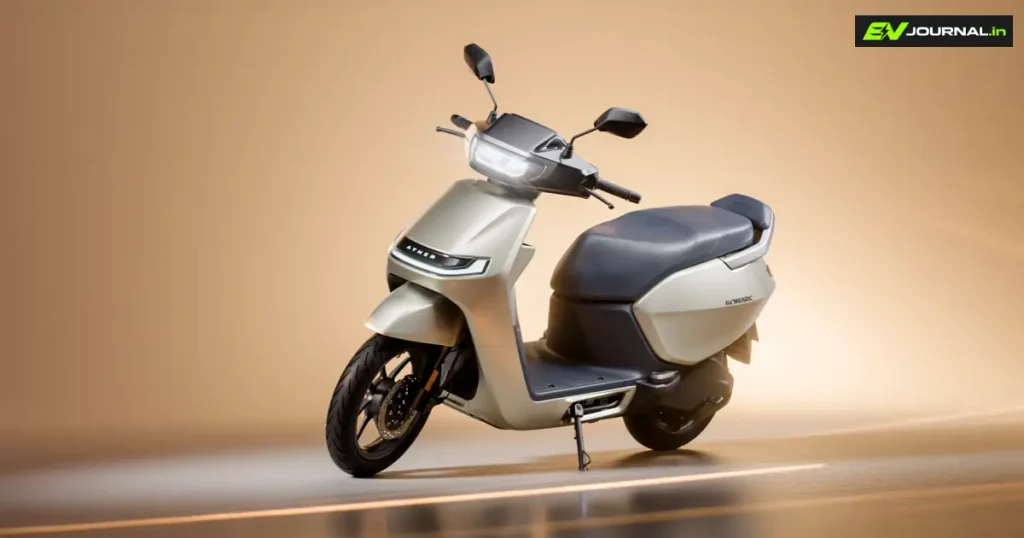
In the manufacturing of electric two-wheelers, the costs of battery materials, metals, electronics, and other components are significant. If input costs rise, the company must either absorb the impact—thereby squeezing its margins—or consider adjusting its pricing. Both scenarios can be challenging for the business.
Ather has managed to report margin improvements despite elevated commodity costs and supply-chain pressures. The future trajectory of these costs could significantly impact the company’s profitability.
Competition and pricing pressure
The Indian electric scooter market is highly competitive. To attract customers, companies must focus on product features, range, service networks, financing options, and pricing.
If intense competition necessitates higher discounts, margins could come under pressure, even if sales volumes continue to grow. Therefore, looking solely at sales growth is not sufficient.
The profit is currently very small
A net profit of Rs. 1.26 crore is quite small when compared to a quarterly revenue from operations of Rs. 1,464.24 crore. While this indicates that the company has entered positive territory, its reported net margin remains thin.
Should expenses rise or margins face pressure, the company could easily slip back into a loss. Consequently, the results of a single quarter should not be viewed as definitive proof of a permanent turnaround.
Why Is Ather Expanding Its Capacity?
Ather has announced plans to expand its manufacturing capacity to meet demand.
According to the company’s announcement, it intends to increase the annual capacity at its Hosur facility in Tamil Nadu by 75,000 units and add an additional annual capacity of 150,000 (1.5 lakh) units at its upcoming ‘Factory 3.0’ in Chhatrapati Sambhajinagar, Maharashtra.
Combined, these expansions aim to bring the total installed annual capacity to approximately 1.14 million (11.4 lakh) units by the second quarter of the 2028 fiscal year (Q2 FY28). The company has announced an investment of approximately Rs. 122 crore for these capacity enhancements.
While capacity expansion can help meet future demand, it also introduces execution risks. Effectively utilizing the additional capacity, maintaining production quality, and aligning output with actual demand will be crucial.
If demand remains strong, this expansion could support growth. However, if demand falls short of expectations, it may take longer to fully realize the benefits of the additional capacity.
What Does This News Mean for EV Buyers?
For Ather’s customers, a profitable quarter is a financial milestone; however, the decision to purchase a scooter should not be based solely on a single quarter’s financial results.
Buyers should evaluate factors based on their specific needs, such as real-world range, access to charging infrastructure, the availability of service centers, warranty terms, battery coverage, the availability of spare parts, and the total cost of ownership.
While a financially stronger business can support long-term product development and service operations, a single profitable quarter does not, in itself, guarantee future service quality or product reliability.
For those considering an Ather vehicle, a practical approach would be to verify the current model specifications, local service availability, and the written warranty terms before making a purchase.
Verdict: A Positive Milestone, But Future Quarters Will Be Key
Ather Energy Q2 FY27 Results represent an important milestone for the company. Revenue from operations increased by approximately 63%, vehicle volumes grew by 42%, and the company reported a consolidated net profit of Rs. 1.26 crore, compared to a loss of Rs. 154.07 crore in the same quarter last year.
An improved EBITDA margin and an increasing share of non-vehicle revenue are also encouraging indicators. However, the net profit remains quite small relative to revenue, and factors such as raw material costs, competition, pricing pressure, and the execution of capacity expansion could impact future performance.
Therefore, the most balanced conclusion at this stage is that while Ather has taken an important step toward profitability, it will be necessary to observe the results of the coming quarters to confirm a sustainable turnaround.
For readers following the EV market, the focus should now be not just on scooter sales, but also on margins, cash generation, operating costs and consistent profitability.
Source note: This article is based on Ather Energy Q2 FY27 Results and company disclosures reported on 26 October 2026, along with Reuters coverage. Financial figures refer to the quarter ended 30 September 2026. Company-reported performance figures should not be interpreted as a guarantee of future results.
Also Read: Ultraviolette X-47 Venom: What Do You Get for Rs. 2.65 Lakh?