
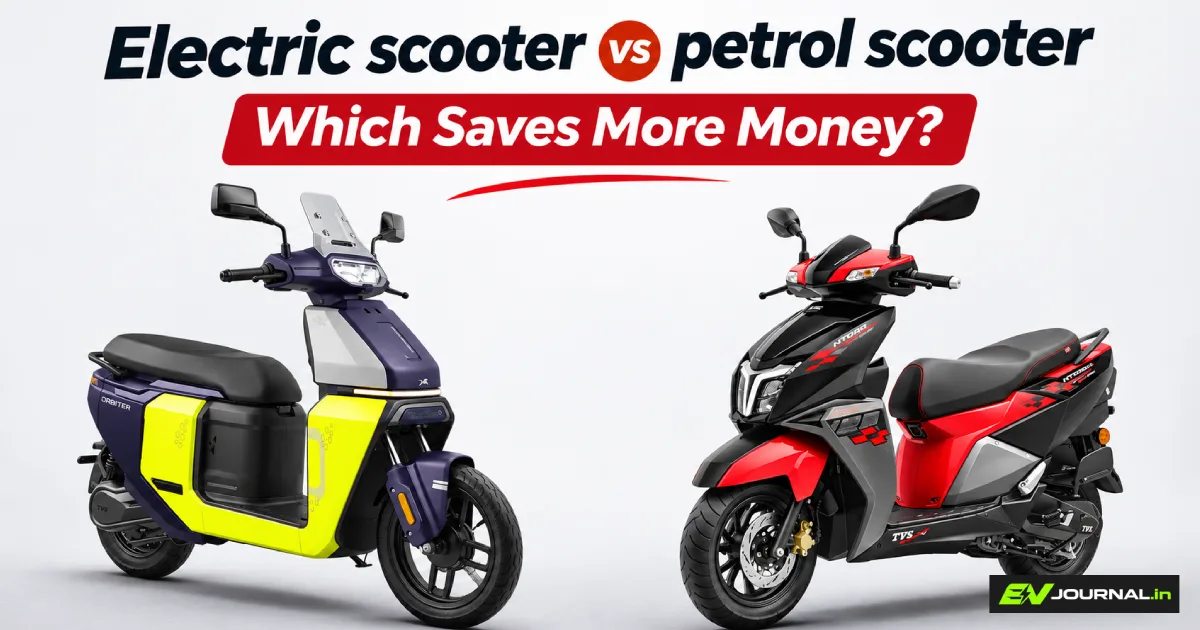
The competition between electric scooters and petrol scooters has become quite interesting. With the growing popularity of electric two-wheelers in India, a common question facing buyers is: Electric scooter vs. petrol scooter, which is more economical in the long term?
Both options have their advantages and disadvantages. Petrol scooters have traditionally been popular for convenient refueling, established service networks, and wide availability. On the other hand, electric scooters offer lower running costs, fewer routine mechanical components, and home charging convenience.
Follow EVJournal.in on X for the latest EV news & updates instantly!
But it would be unfair to declare a scooter cheaper simply by comparing charging costs and petrol prices. Factors such as purchase price, servicing, battery replacement, insurance, and resale value also affect the total ownership cost.
In this guide, we’ll compare electric scooters and petrol scooters in terms of running cost, maintenance, battery life, and long-term ownership.
Also Read: Top 5 Long-Range Electric Scooters in India Under Rs. 1.5 Lakh (2026 Edition)
Electric Scooter vs Petrol Scooter: Key Differences
The biggest difference between electric and petrol scooters is their powertrain and energy source.
Electric scooters operate with a rechargeable battery and electric motor. They can be charged at home using a compatible charging setup. Petrol scooters have an internal combustion engine that generates power by burning petrol.
| Comparison | Electric Scooter | Petrol Scooter |
|---|---|---|
| Energy source | Electricity | Petrol |
| Powertrain | Electric motor | Petrol engine |
| Running cost | Generally lower | Generally higher |
| Routine maintenance | Comparatively simpler | More mechanical servicing |
| Refueling | Charging required Petrol Pump | |
| Battery | Traction battery Conventional starter battery | |
| Engine Oil | Not required for electric motor. Required | |
| Exhaust emissions No tailpipe emissions Tailpipe emissions | ||
| Range | Model and battery dependent | Tank capacity and mileage dependent |
Electric scooters do not require engine oil changes, spark plugs and conventional engine servicing. However, maintenance of tyres, brakes, suspension, bearings and other components is required in both types of scooters.
1. Electric Scooter vs Petrol Scooter: Running Cost Comparison
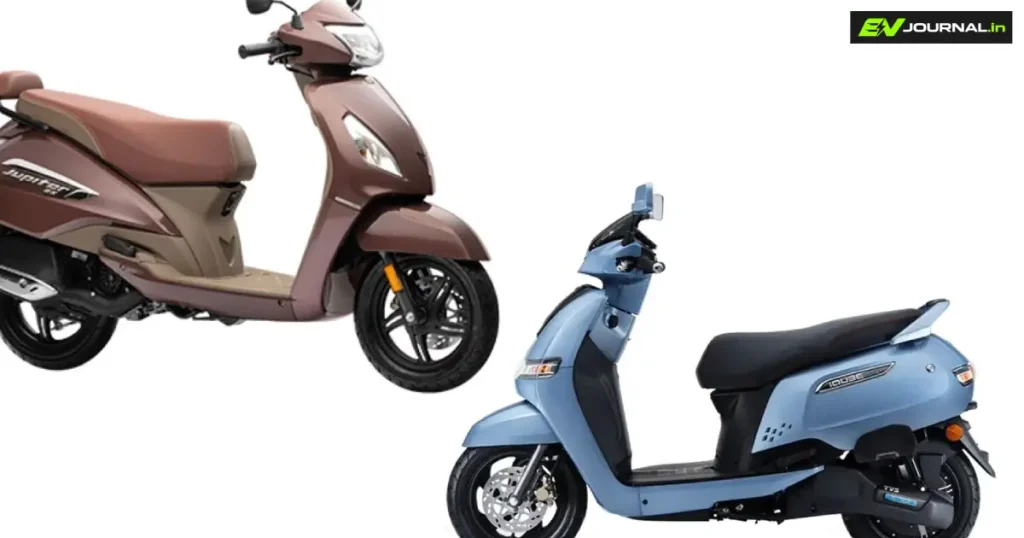
Running cost is the most important factor of comparison. For buyers who commute daily, the difference between electricity and petrol expenses could be significant in the long term.
However, to calculate actual savings, we must consider electricity consumption, petrol mileage, and local energy prices.
Electric Scooter Charging Cost
Electric scooter electricity consumption varies depending on the model, battery capacity, riding speed, rider weight, traffic conditions, and riding style.
The reported average specific energy consumption for electric two-wheelers in India is approximately 2.67 kWh per 100 km. Actual scooter consumption may differ from this average.
To include charging losses, we are assuming approximately 10% additional electricity consumption in this example.
According to this calculation:
- Energy consumption: 2.67 kWh per 100 km
- Charging loss assumption: 10%
- Approximate electricity drawn: 2.94 kWh per 100 km
- Assumed electricity tariff: Rs 7 per unit
By this calculation, the approximate charging expense for traveling 100 km would be Rs 20.58.
Petrol Scooter Running Cost
The running cost of a petrol scooter depends primarily on fuel efficiency and local petrol prices.
For comparison, we are assuming an illustrative mileage of 45 kmpl. This is not the claimed or guaranteed mileage for any specific scooter.
The reported retail price of petrol in Indore on November 12, 2026, was approximately Rs 114.61 per liter.
According to this calculation:
Petrol mileage: 45 kmpl
Petrol price: Rs 114.61 per liter
- Fuel required for 100 km: 2.22 liters
- Approximate fuel expense: Rs 254.69 per 100 km
Electric vs Petrol Running Cost
| Parameter | Electric Scooter | Petrol Scooter |
|---|---|---|
| Distance 100km | 100km | |
| Energy consumption 2.94 units | 2.22 liters | |
| Assumed energy price Rs 7/unit | Rs 114.61/litre | |
| Approximate cost | Rs 20.58 | Rs 254.69 |
In this illustrative comparison, the energy expense of an electric scooter is considerably lower than that of a petrol scooter.
However, electricity tariffs and petrol prices vary city-wise. Electricity bills may also include applicable fuel adjustments, electricity duty, and other charges. Actual charging costs may therefore vary.
Also Read: Electric Scooter Charging Cost Per Month in India (2026): What Will You Actually Pay?
2. Monthly and Yearly Running Costs
Now let’s consider monthly ownership expense.
Suppose a person travels approximately 1,000 km per month, including daily commuting and occasional personal use.
According to the assumptions used above:
| Expense | Electric Scooter | Petrol Scooter |
|---|---|---|
| Monthly distance | 1,000 km | 1,000 km |
| Monthly energy expense | Rs 206 | Rs 2,547 |
| Yearly energy expense | Rs 2,470 | Rs 30,563 |
In this example, the electric scooter could result in a difference of approximately Rs 28,000 in annual energy expense.
But this is not a guaranteed annual saving. This calculation is based only on assumed consumption and prices.
If the electricity tariff increases, petrol prices decrease, or the actual mileage of the petrol scooter improves, the comparison will change.
Similarly, charging rates at public charging stations may be higher than domestic electricity tariffs.
3. Maintenance Cost: Which Scooter Is Cheaper?
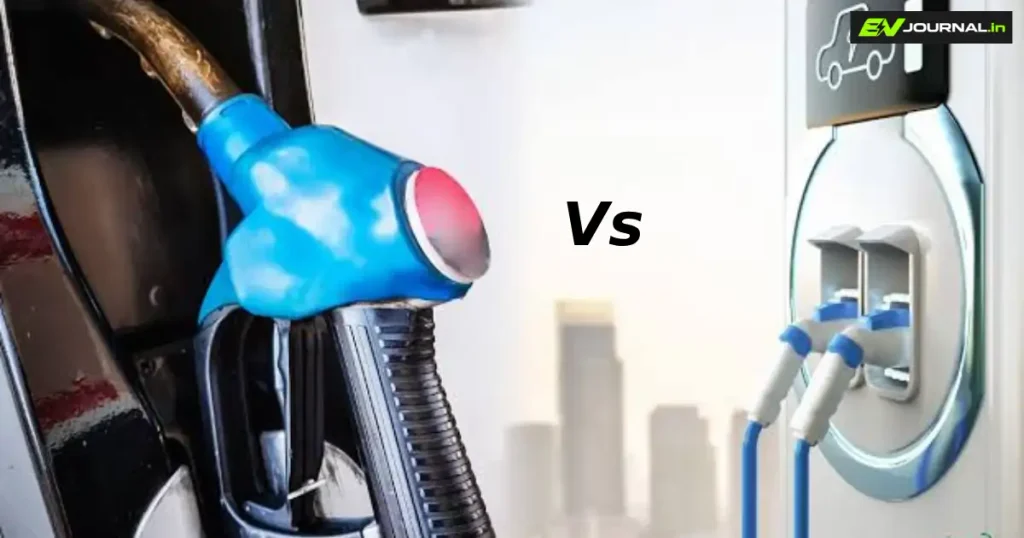
After running costs, maintenance is also an important part of long-term ownership.
Electric Scooter Maintenance
There are no conventional petrol engines in electric scooters. Therefore there is no need for engine oil replacement, spark plug replacement, air filter servicing and engine-related maintenance.
Electric scooter owners have to pay attention primarily to components:
- Tires and brake pads
- Suspension components
Bearings and moving parts - Electrical connections
Battery Management System
Motor and controller - Brake fluid, where applicable
Maintenance in electric scooters may be comparatively simpler, but that does not mean zero maintenance.
In case of fault in battery, motor, controller and electronic components, the repair cost may vary according to the model and manufacturer support.
Petrol Scooter Maintenance
Along with regular servicing, additional engine-related components also have to be maintained in petrol scooters.
Common maintenance requirements include:
- Engine oil replacement
- Air filter cleaning or replacement
Spark plug inspection - Transmission and CVT-related servicing
- Brake pads and tires
Battery maintenance - Other engine-related components
The servicing schedule of petrol scooter should be followed according to the manufacturer’s recommendations.
Overall, electric scooters are comparatively simpler from the perspective of routine mechanical maintenance. But the actual annual maintenance expense will depend on the model, usage and service requirements of both the scooters.
4. Battery Replacement Cost and Long-Term Ownership
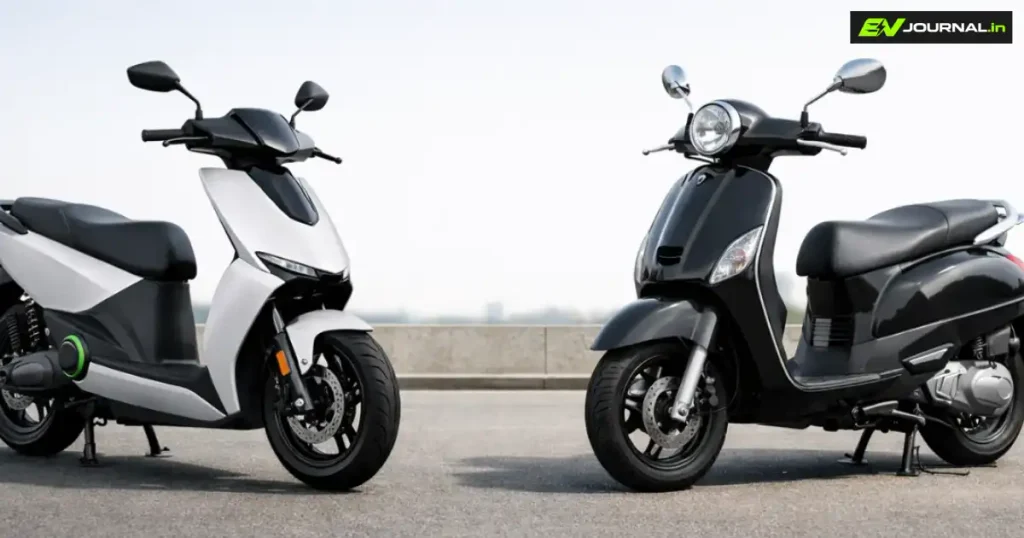
Battery is one of the most important components when purchasing an electric scooter.
Lithium-ion battery performance can degrade over time. The level of battery degradation depends on factors such as charging habits, temperature, usage patterns, battery chemistry, and thermal management.
Therefore, it would be wrong to assume that every electric scooter battery will need to be replaced every 3 or 5 years.
Battery replacement requirements should be condition-based, not based on a fixed assumption.
Buyers should check the following details when purchasing an electric scooter:
- Battery warranty duration
- Battery warranty kilometer limit
- Warranty covered components
- Battery capacity degradation conditions
- Replacement battery availability
- Out-of-warranty replacement cost
According to EV information from the Bureau of Energy Efficiency, battery warranties can vary by electric vehicle category and manufacturer.
Petrol scooters also have a conventional starter battery, but its replacement is not an expense category like traction battery replacement.
The potential battery replacement cost of an electric scooter should not be ignored when calculating long-term ownership. Furthermore, battery replacement should not be considered a mandatory expense without evidence.
5. Purchase Price: Electric vs Petrol Scooter
Electric scooters may have lower running costs, but petrol scooters can still be competitive in terms of initial purchase price.
Entry-level, mid-range, and premium models are available in both categories.
The purchase price of an electric scooter varies depending on battery capacity, motor performance, range, features, and manufacturer.
The pricing of a petrol scooter depends on engine capacity, brand, features, and variant.
Buyers should compare the following expenses while taking purchase decision:
- Ex-showroom price
- Registration and applicable taxes
- Insurance
- Accessories
- Home charging setup, if required
- Applicable subsidies, if eligible
Government incentives should not be assumed to be automatically available. Buyer should verify the eligibility of applicable central and state schemes at the time of purchase.
When comparing a comparatively expensive electric scooter against a cheaper petrol scooter, it is important to include the initial price difference in the ownership calculation.
6. Which Scooter Is Better for Daily Commuting?
Both electric and petrol scooters can be suitable for daily commuting. The final choice depends on the rider’s daily travel requirements.
Electric Scooter Is Better If:
- Daily commuting distance is predictable.
- Convenient charging is available at home or workplace.
- Reducing daily running costs is a priority.
- Travel is mostly on city roads.
- The real-world range of the selected scooter covers daily requirements.
An electric scooter may be a practical option, especially for buyers who regularly commute in the city and can use a home charging facility.
Petrol Scooter Is Better If:
- Regular charging facilities are not available.
- Long-distance travel is required frequently.
- Refueling convenience is important.
- A petrol scooter better fits the selected budget.
- An existing petrol scooter service network is more convenient in the buyer’s location.
Petrol scooters can be a practical choice for buyers whose travel requirements are unpredictable or charging access is limited.
7. Electric Scooter vs Petrol Scooter: 5-Year Ownership Cost
Long-term comparisons require only monthly fuel costs.
To calculate the Total Cost of Ownership (TCO), one must consider the purchase price, running expenses, maintenance, insurance, battery-related expenses, and resale value.
A simplified formula is:
Total Ownership Cost = Purchase Price + Energy/Fuel Cost + Maintenance + Insurance + Battery Replacement (if required) – Resale Value
For example, if the buyer travels 1,000 km monthly, the total distance traveled over five years would be 60,000 km.
According to our earlier assumptions:
| Expense | Electric Scooter | Petrol Scooter |
|---|---|---|
| Five-year distance | 60,000 km | 60,000 km |
| Energy/fuel expense | Approx. Rs 12,350 | Approx. Rs 1,52,800 |
These figures are illustrative and based on the same assumed electricity tariff, consumption, petrol price and mileage. Future price changes are not included.
In comparison the energy expense of electric scooter is substantially lower.
However, to calculate the complete five-year ownership cost, the actual purchase prices, insurance, servicing, possible battery expenses and resale values of both the scooters will have to be added.
Therefore, it would not be accurate to declare an electric scooter universally cheaper based solely on fuel savings.
8. Electric Scooter vs Petrol Scooter: Which One Should You Buy?
If your primary focus is reducing daily running expenses and home charging facilities are available, an electric scooter can be a strong option.
Electric scooters have comparatively lower energy costs and require no conventional engine-related maintenance.
On the other hand, petrol scooters offer established refueling infrastructure, a familiar ownership experience, and freedom from charging dependency.
First-time buyers should carefully evaluate their daily running distance, available charging facilities, budget, and the selected scooter’s warranty before purchasing.
Also, avoid basing decisions solely on advertised range or claimed mileage. Performance may vary under real-world usage conditions.
EVJournal Says…
Electric scooters have a clear advantage in terms of long-term running costs when comparing Electric Scooter vs Petrol Scooter. Especially for buyers with high daily usage and convenient home charging, electricity costs can be significantly lower than petrol costs.
However, a complete ownership comparison cannot be made without considering the initial purchase price, battery warranty, replacement cost, servicing, and resale value.
If you primarily commute within the city, your daily distance is predictable, and charging facilities are available, an electric scooter may be a sensible investment.
But if charging access is limited and you frequently travel long distances, a petrol scooter may still be a practical choice.
Ultimately, the best scooter is the one that fits your daily usage, budget and ownership requirements.
Also Read: Fixed vs Removable Battery: Which EV Is Better in India?